
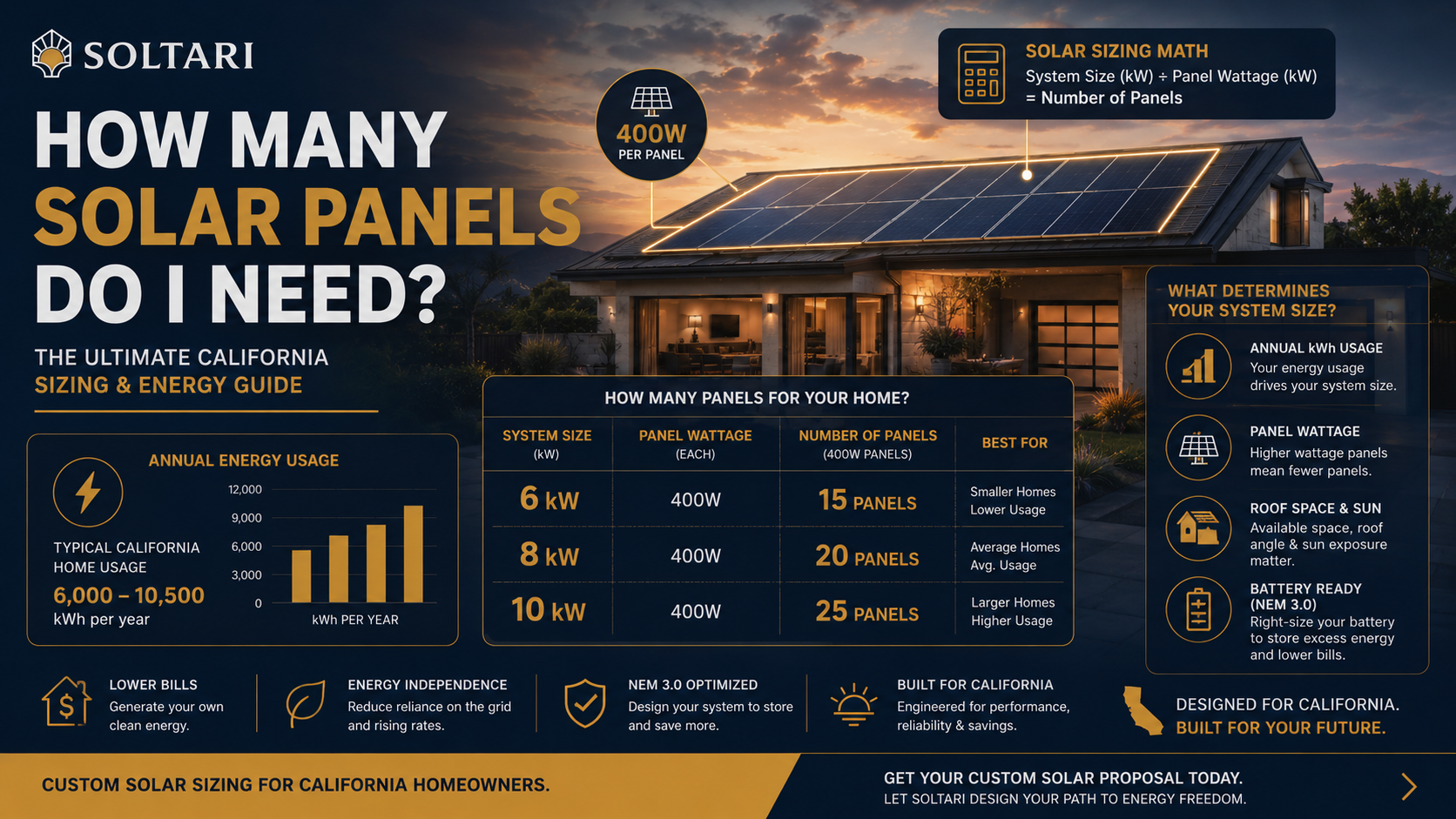
The decision to transition your home to solar power immediately brings up one fundamental question: “how many solar panels do i need” to run my household comfortably? Sizing a system incorrectly can lead to two major financial pitfalls: an undersized system that leaves you dependent on expensive utility grid power, or an oversized system that wastes valuable generation capacity. This comprehensive guide breaks down how to calculate your home’s exact energy usage, details the mathematical formula used to determine how many solar panels to power a house, and explains how the latest California Net Billing Tariff (NEM 3.0) shapes modern system sizing.
Understanding the Core Factors of Sizing Your Home Solar Installation
Calculating your total panel requirement is a highly customized process based on three critical variables.
What Determines How Many Solar Panels Do I Need for My House
The number of solar modules your home requires is dictated by three primary factors:
-
Your Annual Electricity Usage: The total number of kilowatt-hours (kWh) your household consumes in a 12-month period.
-
The Panel’s Wattage Rating: The power output capacity of the specific panels you choose (e.g., 400-watt vs. 450-watt panels).
-
Local Sunlight Hours (Production Ratio): The amount of solar radiation your specific region receives annually. For homeowners in Northern California, working with licensed solar specialists guarantees that these complex engineering calculations are completed with absolute precision.
How Many Solar Panels to Power a House on Average
On average, a typical residential home in the United States consumes approximately 10,500 kWh of electricity per year.
-
The System Size: To offset 100% of this electrical load, most homes require an 8kW to 10kW solar system.
-
The Panel Count: If you utilize modern, high-efficiency 400-watt panels, this translates to needing between 20 and 25 solar panels to completely power the house under normal conditions.
Calculating Your Annual Kilowatt-Hour Energy Consumption
Before design begins, you must review your historical utility bills (such as PG&E) to find your total annual consumption.
-
The Calculation: Look for your average monthly usage in kilowatt-hours (kWh). If your average monthly consumption is 800 kWh, your annual consumption is 9,600 kWh.
-
Seasonal Fluctuations: Be sure to analyze your usage during peak summer months (when air conditioning loads are high) and winter months (when heating loads increase) to ensure your system is sized to handle seasonal spikes safely.
Technical Sizing Math: Panel Wattage, Roof Space, and Efficiency
Translating your annual energy needs into a physical rooftop array requires calculating the structural limits of your property.
How Individual Panel Wattage Changes Your Total Panel Count
The power rating of your solar panels directly impacts the physical size of your array:
| System Size | Panels Needed (using 350W panels) | Panels Needed (using 400W panels) | Panels Needed (using 450W panels) |
| 6 kW System | 17 Panels | 15 Panels | 13 Panels |
| 8 kW System | 23 Panels | 20 Panels | 18 Panels |
| 10 kW System | 29 Panels | 25 Panels | 22 Panels |
| 12 kW System | 34 Panels | 30 Panels | 27 Panels |
Utilizing higher-wattage panels is the best way to keep your physical panel count as low as possible, reducing the required footprint on your roof. This is a core design standard when engineering high end solar power systems.
Assessing Your Usable Roof Space and Shading Limitations
Your roof’s physical layout can limit the number of panels you can safely install.
-
Setback Rules: Local fire codes require a minimum of 3 feet of clear space along the edges and ridges of your roof for emergency access.
-
Obstructions: Skylights, chimneys, vents, and valleys reduce the continuous flat area available for solar mounting.
-
Shading: If parts of your roof are shaded by mature trees or neighboring structures, those areas must be excluded from the system design to prevent dragging down the efficiency of the entire array.
Why Solar Panel Efficiency Ratings Matter for Small Roofs
If your roof space is highly constrained, choosing premium, high-efficiency panels (such as those from Maxeon or REC) is critical. Higher efficiency means the panels can generate more power per square inch, allowing you to meet your energy goals with a much smaller physical array.
The Sizing Math Under California NEM 3.0 and Battery Storage
In California, the introduction of the Net Billing Tariff (NEM 3.0) has fundamentally changed how we size residential solar systems.
Why Sizing Your Array to Match Your Home Battery is Essential
Under NEM 3.0, exporting excess solar energy to the grid is no longer highly compensated. Therefore, your system must be sized for self consumption.
-
The Strategy: You must size your solar array to generate enough power to run your home during the day and fully charge your home battery storage systems before the sun goes down.
-
The Avoided Cost: This stored energy is then discharged during the expensive evening peak utility hours (4 PM to 9 PM), ensuring you avoid purchasing power from the utility at peak rates.
Sizing for Future Electric Vehicle Charging and Heat Pump Demands
When calculating your required panel count, always future-proof your system:
-
Electric Vehicles: A standard EV driven 12,000 miles per year requires approximately 2,500 to 3,000 kWh of extra electricity annually, which requires adding 6 to 8 extra panels to your system.
-
Heat Pumps: Transitioning from natural gas to electric heat pumps or heat pump water heaters will significantly increase your electrical load, requiring careful scaling of your solar array.
The Importance of a Professional Load Analysis for Accurate Sizing
The only way to guarantee your system is sized correctly is through a professional engineering load audit. At Soltari, LLC, our team of custom designers analyzes your hourly usage patterns, roof angles, and future electrification goals to ensure your system is perfectly engineered for long-term payback and reliability.
Designing Your Custom Solar Installation
Why NABCEP Certified System Design Guarantees High Performance
Because solar energy is an infrastructure-grade asset, your system’s design must be handled by certified professionals. NABCEP-certified designers ensure that your system’s string layout, inverter sizing, and structural mounts are engineered safely to last over 25 years in California’s challenging coastal climate.
Request Your Custom Solar Sizing and Payback Analysis Today
Don’t rely on generic online calculators that don’t account for your specific roof pitch, shading, or local utility rates. Get a professional, customized engineering assessment tailored to your home. Request a customized quote now to secure your precise, compliant, and optimized system design.
Frequently Asked Questions About Solar Sizing
Can I buy a standard solar panel kit and install it myself?
No, DIY solar installation is not recommended. Solar installations involve high-voltage DC electrical work, structural roof penetrations, building permits, and utility coordination (like PG&E) that must legally be handled by a licensed C10 electrical contractor to ensure safety and system approval.
How much roof space do I need for a standard home solar system?
An average residential solar panel measures roughly 17.5 square feet. For a standard 8kW system requiring 20 panels, you will need approximately 350 to 400 square feet of clear, unshaded roof space, excluding fire setbacks.
What is the difference between a potential hazard and a developing hazard in solar sizing?
In solar terms, a potential hazard would be an older, un-upgraded electrical panel that could support solar but risks failure. A developing hazard is a system that is actively over-producing energy without battery storage under NEM 3.0, resulting in wasted generation and poor financial return.
How long does the actual physical solar installation take?
For a standard residential system (15-25 panels), the physical installation typically takes 1 to 2 days. However, the overall process including engineering, permitting, utility approval, and final inspection can take 4 to 8 weeks.
What happens to my solar production during a cloudy or rainy winter day?
Solar panels will still generate electricity on cloudy days, but their output will drop to 10-25% of their typical capacity. Sizing your system with adequate battery storage or a backup generator is essential to handle consecutive low-production winter days safely.
Why is proper grounding critical for a rooftop solar installation?
Proper grounding directs accidental electrical surges (such as lightning strikes or short circuits) safely into the earth, protecting your home’s electrical system, appliances, solar inverters, and battery storage units from severe damage. Always ensure a licensed C10 electrician handles your system’s grounding.


One Response
An unbranded drug is a preparation that includes the identical active ingredient as the innovator product.
This type of product is produced when the intellectual property rights on the reference product lapses, enabling other companies to market versions.
These generics are substantially less expensive than brand-name drugs, primarily because they do not incur the heavy investments of research and advertising.
However, every generic product must successfully complete rigorous bioequivalence tests to ensure that it works equally well as the reference medication.
iMedix premature ejaculation information