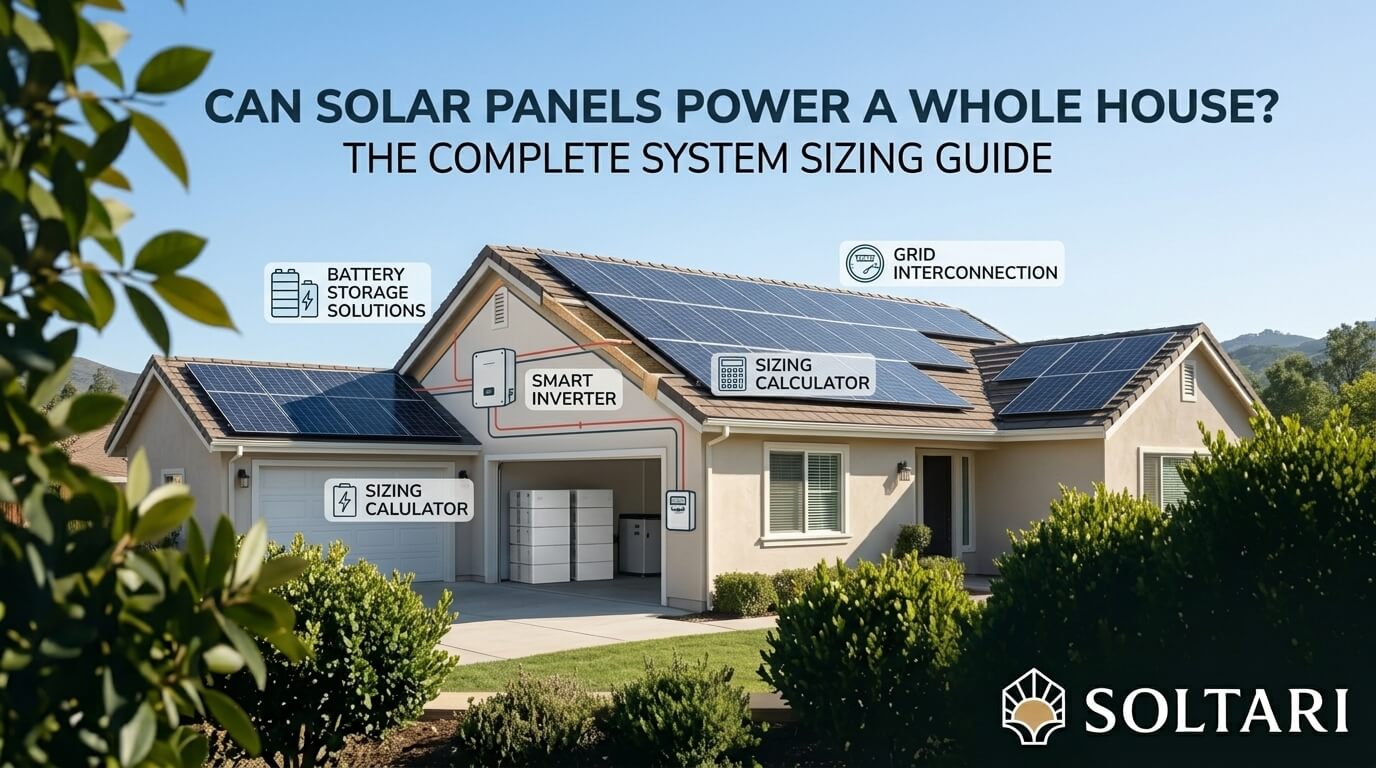
Learning how to connect solar panels to house electrical infrastructure is one of the most critical phases of any clean energy installation. Whether you are adding a rooftop array or a ground-mount system, connecting solar power to your main service panel involves high-voltage electrical engineering, grid safety compliance, and strict building codes. If you want to know how to connect solar panels to house circuits safely, you must understand how direct current (DC) power from your panels is converted into alternating current (AC) power for your appliances. This comprehensive guide covers every aspect of how to wire solar panels to house systems, explains the function of solar inverters, and outlines the mandatory electrical codes required in California.
Understanding the Electrical Flow When You Connect Solar Panels to House Circuits
To understand how to connect solar panels to house power grids, you must first trace the journey electricity takes from sunlight absorption to your wall outlets.
Direct Current Generation at the Photovoltaic Array
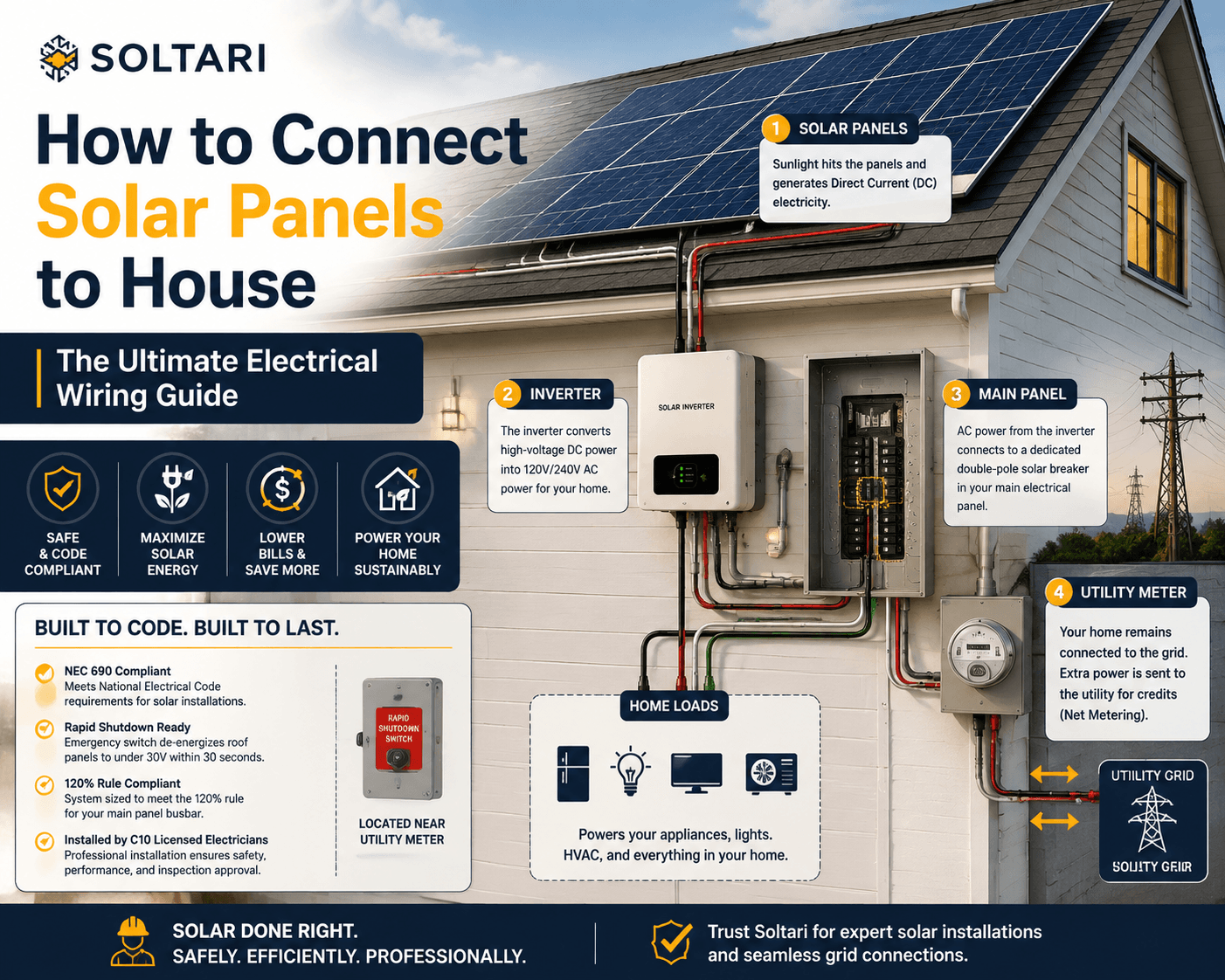
When sunlight hits your solar panels, photovoltaic cells generate direct current (DC) electricity.
-
Series Wiring: Panels are connected together in “strings” where the positive terminal of one panel links to the negative terminal of the next. This increases total voltage while keeping amperage constant.
-
Parallel Wiring: Panels are wired side-by-side to increase amperage while keeping voltage constant.
-
The Array Cable: High-voltage DC current travels from the roof array down through heavy-duty, weather-resistant conduit wiring toward the inverter. Knowing how to connect solar panels to house arrays properly requires understanding these series and parallel voltage limits.
Inverter Conversion Converting DC to AC Power
Your household appliances cannot run on DC power directly.
-
The Inverter’s Job: The DC wiring feeds into a solar inverter (or microinverter system), which converts high-voltage DC power into 120V/240V alternating current (AC) electricity.
-
Frequency Matching: The inverter synchronizes the frequency of the solar power (60 Hz in the United States) with the power supplied by your local utility company.
Main Electrical Panel Connection and Circuit Breakers
Once converted to AC power, the electricity must be safely introduced into your home’s breaker box.
-
The Solar Breaker: The AC output wires from the inverter connect to a dedicated double-pole circuit breaker installed inside your main electrical panel.
-
Power Distribution: Once the power enters the main panel busbar, it naturally flows to any household appliance currently drawing electricity, such as your refrigerator, lights, or air conditioner.
Electrical Safety Codes and NEC Requirements for Home Connections
Working with high-voltage electricity requires strict adherence to safety standards established by the National Electrical Code (NEC).
National Electrical Code NEC 690 Guidelines for Solar Wiring
When learning how to connect solar panels to house electrical systems, you must comply with NEC Article 690, which governs solar photovoltaic installations.
-
Rapid Shutdown Switches: NEC 690 requires an emergency rapid shutdown switch located near your main utility meter. In an emergency, firefighters can flip this switch to immediately de-energize all solar DC wiring on the roof to under 30 volts within 30 seconds.
-
Conduit Grounding: All metal racking, panel frames, and electrical boxes must be bonded to a continuous grounding wire that connects to your home’s grounding rod.
The 120 Percent Rule for Main Panel Busbars
A major technical constraint when learning how to wire solar panels to house breaker boxes is the NEC 120% Rule.
-
The Math: The combined amperage of your main utility breaker and your solar breaker cannot exceed 120% of the main panel busbar’s total rated capacity.
-
Example: On a standard 200-amp electrical panel with a 200-amp busbar, 120% equals 240 amps. Subtracting the 200-amp main breaker leaves a maximum of 40 amps for your solar backfeed breaker. If your solar array requires more than 40 amps, you must perform a main panel upgrade.
Why C10 Licensed Electricians Are Required for Grid Hookups
Attempting to figure out how to connect solar panels to house wiring yourself carries severe risks of electrical shock, house fires, and invalidated homeowners insurance. Partnering with a California certified solar power company guarantees that your system is installed by C10 licensed electrical contractors who perform precise load calculations and handle all municipal inspections.
Step-by-Step Technical Overview of How to Wire Solar Panels to House Systems
While physical installation must be completed by professionals, understanding the wiring sequence helps homeowners monitor their installation progress.
Connecting Panels in Series or Parallel to Inverters
The first stage of learning how to wire solar panels to house setups occurs on the roof deck.
-
String Inverters: Panel cables are connected in series using waterproof MC4 connectors, creating high-voltage DC strings that run down the side of the house to a central inverter. This configuration is widely used in residential photovoltaic panel setups.
-
Microinverters: A small microinverter is mounted directly underneath each solar panel on the roof. The microinverter converts DC to AC right on the roof, meaning only safer AC wiring runs down to your home’s electrical box.
Installing the DC Disconnect and AC Disconnect Switches
Safety codes mandate two physical shutoff switches between your roof and your main panel:
-
DC Disconnect: Located between the solar array and a string inverter, allowing technicians to safely cut power from the panels during maintenance.
-
AC Disconnect: Located between the inverter and your main breaker panel (usually mounted next to your utility meter), allowing utility workers to isolate your system during grid repairs.
Connecting Solar Inverters to the Main Electrical Breaker Box
The final electrical hookup involves connecting the AC output from your inverter to your main panel:
-
Backfeed Breaker: The AC wires connect to a dedicated solar breaker positioned at the opposite end of the main utility breaker on the busbar.
-
Bi-Directional Metering: Your utility provider (such as PG&E) replaces your standard electric meter with a bi-directional smart meter that tracks both the power you consume from the grid and the excess solar electricity you export.
Integrating Home Emergency Power Storage with Your Solar Connection
If your installation includes battery backup, the wiring path is slightly modified.
-
The Backup Gateway: Power from the inverter first routes into a smart automatic transfer switch (such as a Tesla Backup Gateway) before connecting to your main panel.
-
Outage Protection: When a grid outage occurs, the gateway disconnects your home from the utility grid in under 20 milliseconds and routes stored energy from your home emergency power storage directly into your essential household circuits.
Commercial Solar Interconnection for High-Voltage Facilities
On a larger scale, knowing how to connect solar panels to house systems translates into three-phase commercial engineering. Commercial systems operate on 208V, 480V, or higher industrial voltages, requiring custom switchgear, transformers, and dedicated sub-panels designed for commercial solar installation services.
Critical Common Errors to Avoid When Connecting Solar Panels
Improper wiring techniques lead to system inefficiencies, equipment failure, and safety violations.
Undersized Wire Gauges and Voltage Drop
Using electrical wire that is too thin for the distance and amperage causes excessive electrical resistance, known as voltage drop.
-
The Result: Energy generated by your solar panels is wasted as heat inside the wire instead of powering your home. Proper engineering ensures that wire gauges (such as 10-gauge, 8-gauge, or 6-gauge copper) are sized to keep total voltage drop under 2%.
Improper Grounding and Lightning Surge Protection
Failing to properly ground your solar array creates a major electrical hazard. All metal racking rails, panel frames, and inverter enclosures must be connected to your home’s main grounding electrode system. This protects your expensive solar inverters and home appliances from static buildups and nearby lightning strikes.
Connecting Solar Panels Without Municipal Permits and Utility Approval
Connecting your solar system to your home’s electrical box without a building permit or utility interconnection agreement is illegal. Unpermitted installations can result in severe utility fines, forced system shutdowns, and complications when selling your home.
Connecting Your Home to Solar Energy
Connecting solar power to your home is a major infrastructure project that requires experienced engineering and licensed electrical execution.
The Soltari Engineering Standard Precision Electrical Work
At Soltari, LLC, we follow The Way of the Sun approaching every solar installation with craftsmanship, quiet precision, and complete technical integrity. Our team of C10 licensed electricians and NABCEP-certified designers handles every aspect of your project from engineering schematics and load calculations to physical conduit runs and final utility interconnection.
Book an Electrical Wiring Inspection for Your Property
Are you ready to transition your home to clean solar energy or upgrade your existing electrical panel for solar? Don’t risk DIY wiring errors or uncertified contractors. Book an electrical wiring inspection today to receive a comprehensive electrical load evaluation and custom system proposal for your property.
Frequently Asked Questions About Connecting Solar Panels to a House
Can I connect solar panels directly to a wall outlet in my house?
No. Connecting solar panels directly to a standard wall outlet (often called “plug-in solar”) is extremely dangerous and illegal in most jurisdictions. It bypasses essential circuit breaker protection, risks overloading your home’s internal wiring, and creates a lethal backfeed hazard for utility line workers during a power outage.
Do I need to turn off my main breaker when connecting solar panels?
Yes. Any work performed inside your main electrical panel requires de-energizing the busbar by turning off the main service breaker. In many cases, connecting a new solar breaker or performing a main panel upgrade requires coordinating a temporary service disconnect with your local utility company.
What is the difference between AC wiring and DC wiring in a solar system?
DC wiring carries high-voltage direct current electricity from the solar panels on the roof down to the inverter. AC wiring carries alternating current electricity from the inverter to your main electrical panel and throughout your home’s outlets and appliances.
How do microinverters simplify connecting solar panels to a house?
Microinverters perform the DC-to-AC conversion right on the roof under each panel. This means that only safer, standard AC electricity flows through the conduit down your home’s wall to the main breaker panel, eliminating high-voltage DC wiring runs inside your house.
What size circuit breaker do I need to connect my solar system?
The size of your solar circuit breaker depends on your inverter’s maximum continuous AC output. Under NEC codes, the breaker must be rated for 125% of the inverter’s maximum continuous current. For example, an inverter with a 24-amp maximum output requires a dedicated 30-amp double-pole circuit breaker.
Will my solar panels automatically feed electricity to my house during a blackout?
No, not unless you have a battery backup system and an automatic transfer switch installed. Standard grid-tied solar systems automatically shut down during a blackout (anti-islanding protection) to prevent feeding dangerous electricity onto grid lines that utility technicians are repairing.