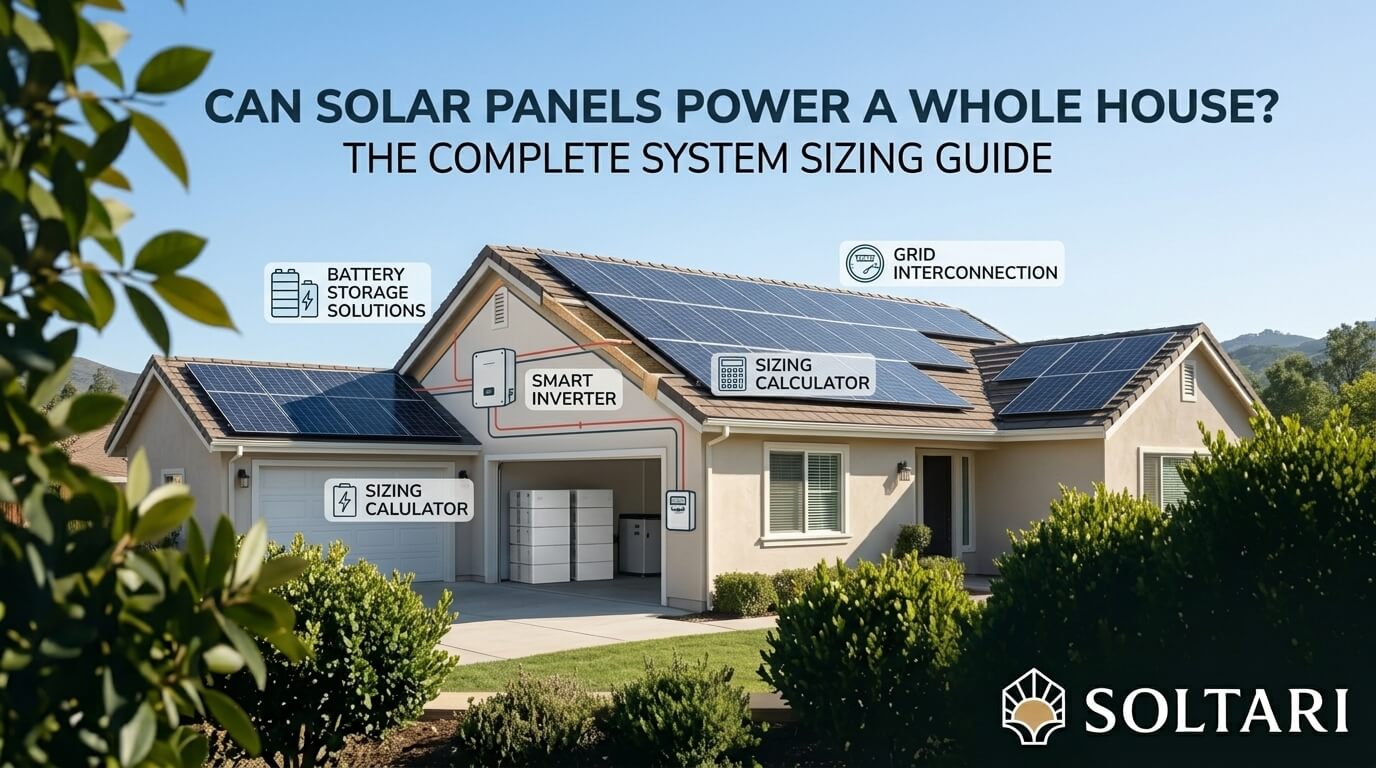
Transitioning your entire household to clean energy is one of the most effective ways to break free from rising utility rates and grid instability. However, before investing in system hardware, every homeowner asks the same core question: can solar panels power a whole house comfortably without sacrificing daily comfort? The short answer is yes, solar panels can power a whole house, provided the system is engineered with adequate panel capacity, inverter output, and energy storage. If you want to know can solar panels power a whole house, you must evaluate your annual kilowatt-hour (kWh) consumption, peak surge loads, and nighttime battery needs. This comprehensive guide breaks down the sizing math, battery requirements, and electrical panel upgrades needed to achieve 100% whole-house power independence.
Understanding How Solar Energy Powers an Entire Household
To determine if can solar panels power a whole house, you must understand the relationship between energy generation, instantaneous power draw, and storage.
What It Means to Can Solar Panels Power a Whole House Off Grid or On Grid
There is a technical difference between powering a home on-grid versus off-grid:
-
Grid-Tied Whole House Solar: Your system generates 100% of the energy your home consumes annually. During sunny day hours, your panels power your appliances and send excess energy to the grid or your battery. At night, you draw power from your battery or the grid.
-
Off-Grid Whole House Solar: Your system operates with zero connection to the utility company. It must be engineered larger to handle consecutive cloudy winter days without ever running out of power.
-
The Baseline: Whether on-grid or off-grid, asking can solar panels power a whole house requires calculating both your daily kilowatt-hour usage and your instantaneous peak wattage. Partnering with a licensed C10 electrical solar team ensures that both parameters are calculated correctly.
Calculating Your Home Baseline Consumption and Peak Power Surge
Powering an entire house requires managing two distinct electrical values:
-
Kilowatt-Hours (kWh) – Total Volume: This is the total amount of energy your home uses over time. An average 2,000 to 2,500 square foot California home consumes between 800 kWh and 1,200 kWh per month (or 9,600 kWh to 14,400 kWh per year).
-
Surge Wattage – Instantaneous Peak: This is the maximum amount of power drawn at any single second when heavy motors start up simultaneously (such as air conditioning compressors, well pumps, or clothes dryers). To safely say can solar power a whole house, your solar inverters must be capable of meeting these surge loads without tripping.
How Many Solar Panels and Kilowatts Are Needed for Whole Home Power
To answer can solar panels power a whole house for an average American family, you must convert your annual kWh usage into system wattage.
-
The System Size: Offsetting 100% of an average home’s energy consumption typically requires a 9 kW to 12 kW solar system.
-
The Panel Count: Utilizing modern 400-watt monocrystalline panels, an 8 kW system requires 20 panels, a 10 kW system requires 25 panels, and a 12 kW system requires 30 panels.
-
Roof Space Needed: Installing 25 to 30 panels requires roughly 400 to 500 square feet of clear, unshaded roof space. Installing whole home solar power arrays ensures your roof footprint is optimized for maximum sun exposure.
The Role of Battery Storage in Running a Whole Home on Solar
Solar panels only generate electricity when the sun is shining. Therefore, asking can solar panels power a whole house 24 hours a day naturally leads to the necessity of energy storage.
Why Whole Home Battery Backup Is Required for Nighttime Electricity
Solar panels stop producing power at dusk. Without a battery bank, a home with solar panels must draw electricity from the utility grid at night.
-
Self-Consumption Strategy: To achieve true whole-home independence under California’s Net Billing Tariff (NEM 3.0), you must store daytime solar energy in batteries.
-
24-Hour Loop: Your panels power your house and charge your batteries during the day. In the evening, your home switches to battery power, ensuring that can solar panels power a whole house remains true around the clock.
Running Heavy Appliances like Air Conditioners and Water Pumps
Heavy appliances present the biggest engineering hurdle when evaluating can solar power a whole house.
-
Air Conditioning (HVAC): Central AC units require massive startup surge currents (often 30 to 50 amps). Installing a “soft starter” on your AC unit reduces this initial power spike, allowing your solar battery system to start the air conditioner smoothly.
-
Well Pumps and Sump Pumps: Homes in rural areas (like the Santa Cruz Mountains) rely on electric well pumps for water. Your battery system inverter must be rated for high continuous output (such as 11.5 kW from a Tesla Powerwall 3) to run well pumps alongside household appliances.
Stacking Multiple Tesla Powerwalls for Continuous Outage Resilience
To guarantee that can solar panels power a whole house during extended grid outages or Public Safety Power Shutoffs (PSPS), stacking multiple battery units is often necessary.
-
Single Battery (13.5 kWh): Powers essential circuits (refrigerator, lights, Wi-Fi, television) for 24 to 48 hours.
-
Dual Batteries (27 kWh): Powers essential circuits plus well pumps, microwave, and small air conditioning units.
-
Triple Batteries (40.5 kWh): Provides complete, uncompromised whole-house power, allowing you to run central AC, electric dryers, and EV chargers during an outage. Integrating whole home battery storage setups guarantees continuous power for large estates.
Electrical Panel and Grid Interconnection Requirements
Feeding enough solar and battery power to run an entire household requires robust electrical distribution infrastructure.
Main Panel Upgrades and Busbar Capacity for Whole House Solar
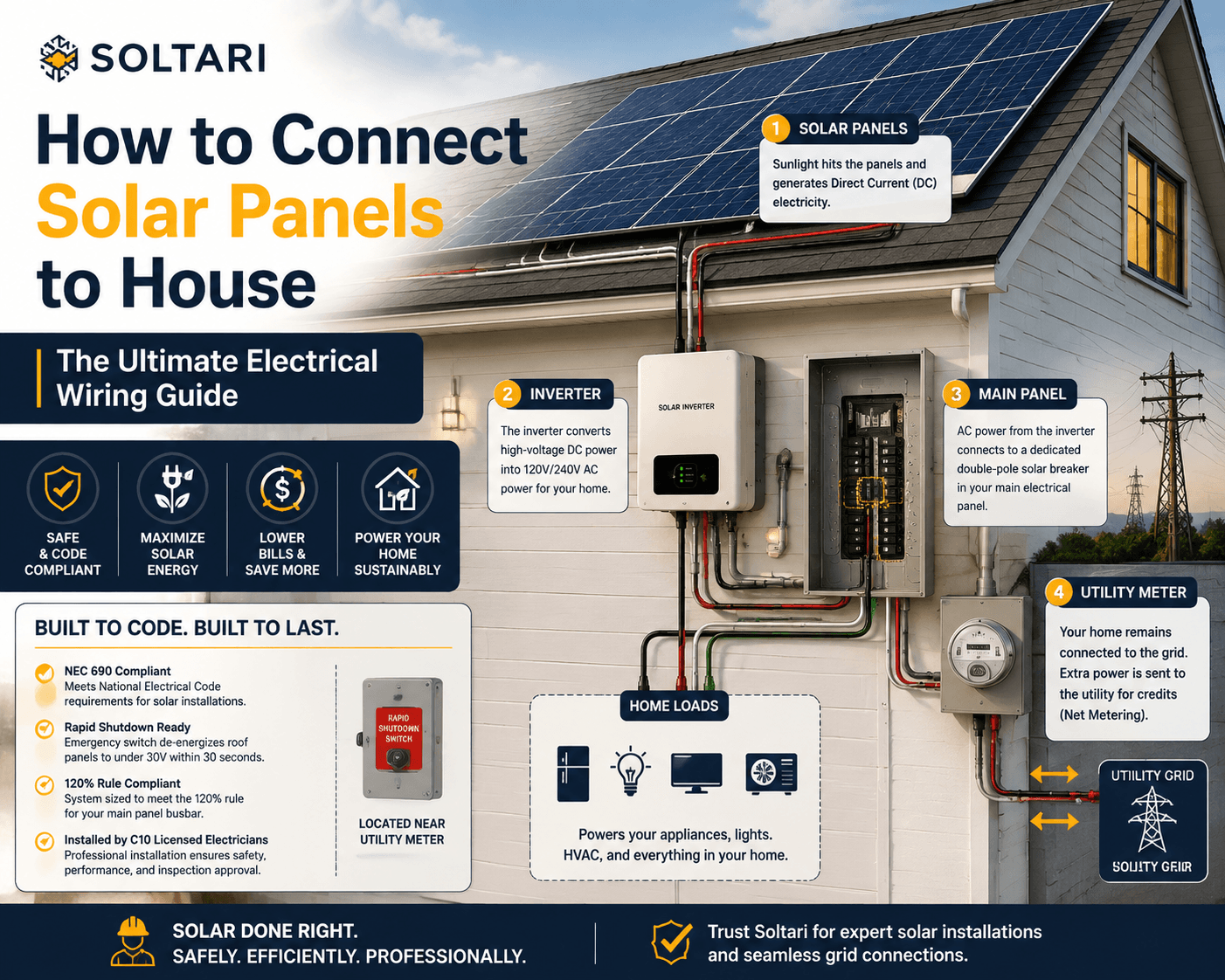
Connecting a 10 kW or 12 kW solar array alongside multiple batteries requires adequate space inside your home’s breaker box.
-
The 100-Amp Limit: Older 100-amp electrical panels cannot safely handle the electrical backfeed from a large whole-home solar array under the National Electrical Code (NEC) 120% Rule.
-
200-Amp to 400-Amp Upgrades: Completing a main panel upgrade (MPU) to 200-amp or 400-amp service provides the busbar capacity needed to route large volumes of solar power throughout your house safely.
Smart Electrical Panels for Intelligent Load Management
To optimize whole-house solar power without buying an excessively large battery bank, smart electrical panels (such as SPAN) offer a revolutionary solution.
-
Automated Load Shedding: During a grid outage, a smart panel automatically turns off non-essential circuits (like hot tubs or secondary guest rooms) and prioritizes power to your refrigerator and medical devices.
-
Extended Battery Life: By managing your power dynamically, a smart panel allows a smaller battery bank to run your home for twice as long during a blackout. This level of control is also vital for high-demand commercial renewable power installations.
Navigating California Net Metering Rules for Whole Home System Design
Under California’s NEM 3.0 rules, sizing a whole-home system requires balancing solar generation with battery capacity. Because utility export credits are low, your whole-home system should be sized to generate just enough electricity to meet your daily household consumption and fully charge your battery bank, minimizing wasted export energy.
Whole-Home Solar System Sizing Reference Table
When asking can solar panels power a whole house, use this reference table to understand the equipment required for different home sizes:
| Home Size & Description | Average Daily kWh Usage | Recommended Solar System Size | Solar Panel Count (400W) | Recommended Battery Storage |
| Small Home (1,000 – 1,500 sq ft) | 15 – 20 kWh / day | 5 kW – 6 kW System | 13 – 15 Panels | 1 Battery (13.5 kWh) |
| Medium Home (1,800 – 2,500 sq ft) | 25 – 35 kWh / day | 8 kW – 10 kW System | 20 – 25 Panels | 1 – 2 Batteries (13.5 – 27 kWh) |
| Large Home (3,000 – 4,000 sq ft) | 40 – 60 kWh / day | 12 kW – 15 kW System | 30 – 38 Panels | 2 – 3 Batteries (27 – 40.5 kWh) |
| Estate with Pool & EV Charger | 60+ kWh / day | 16 kW – 20 kW System | 40 – 50 Panels | 3+ Batteries (40.5+ kWh) |
Design a Whole Home Solar System
Achieving true whole-house energy independence requires working with certified, engineering-led solar experts.
Why C10 Electricians and NABCEP Designers Guarantee Safety
Designing a system that proves can solar panels power a whole house safely involves complex civil engineering, structural roof attachments, and high-voltage three-phase or split-phase wiring. At Soltari, LLC, our team of C10 licensed electrical contractors and NABCEP-certified designers brings quiet precision, technical expertise, and craftsmanship to every system design [2.1.2, 2.2.4, 2.4.8]. We perform comprehensive load calculations to ensure your whole-home solar array operates flawlessly for over 25 years.
Request a Whole Home Energy Proposal for Your Property
Stop wondering whether can solar panels power a whole house like yours. Get an accurate, itemized engineering assessment and financial proposal tailored to your specific appliances, roof layout, and energy goals. Request a whole home energy proposal today to discover how a custom solar and battery system can deliver 100% power independence to your household.
Frequently Asked Questions About Whole House Solar Power
Can solar panels power a whole house without being connected to the utility grid?
Yes, but it requires an off-grid solar system with a large battery bank and a backup generator. Off-grid systems must be engineered larger than grid-tied systems to ensure you have enough stored power to handle consecutive rainy or cloudy winter days without running out of electricity.
How many solar panels does it take to power a 2,000 square foot house?
An average 2,000 square foot home typically requires a 6 kW to 8 kW solar system, which translates to approximately 15 to 20 solar panels (using modern 400-watt monocrystalline panels) depending on your family’s daily energy usage and geographic location.
Can solar panels power a whole house with central air conditioning?
Yes, can solar panels power a whole house with central air conditioning if the system is equipped with an adequate inverter and battery storage. Installing a “soft starter” on your central AC unit reduces the startup surge current, allowing your solar battery to start the compressor smoothly during a power outage.
What happens if my whole home solar panels produce more electricity than my house uses?
On a grid-tied system in California, excess electricity generated during the day is first used to charge your home battery. Once the battery is full, any additional excess power is exported to the utility grid for energy credits under California’s Net Billing Tariff (NEM 3.0) rules.
Will a whole-home solar system increase my property value in California?
Yes. Studies show that homes with owned whole-house solar and battery storage systems sell for 4% to 5% more on average in California compared to homes without solar. Furthermore, California law exempts solar installations from increasing your annual property tax assessment.