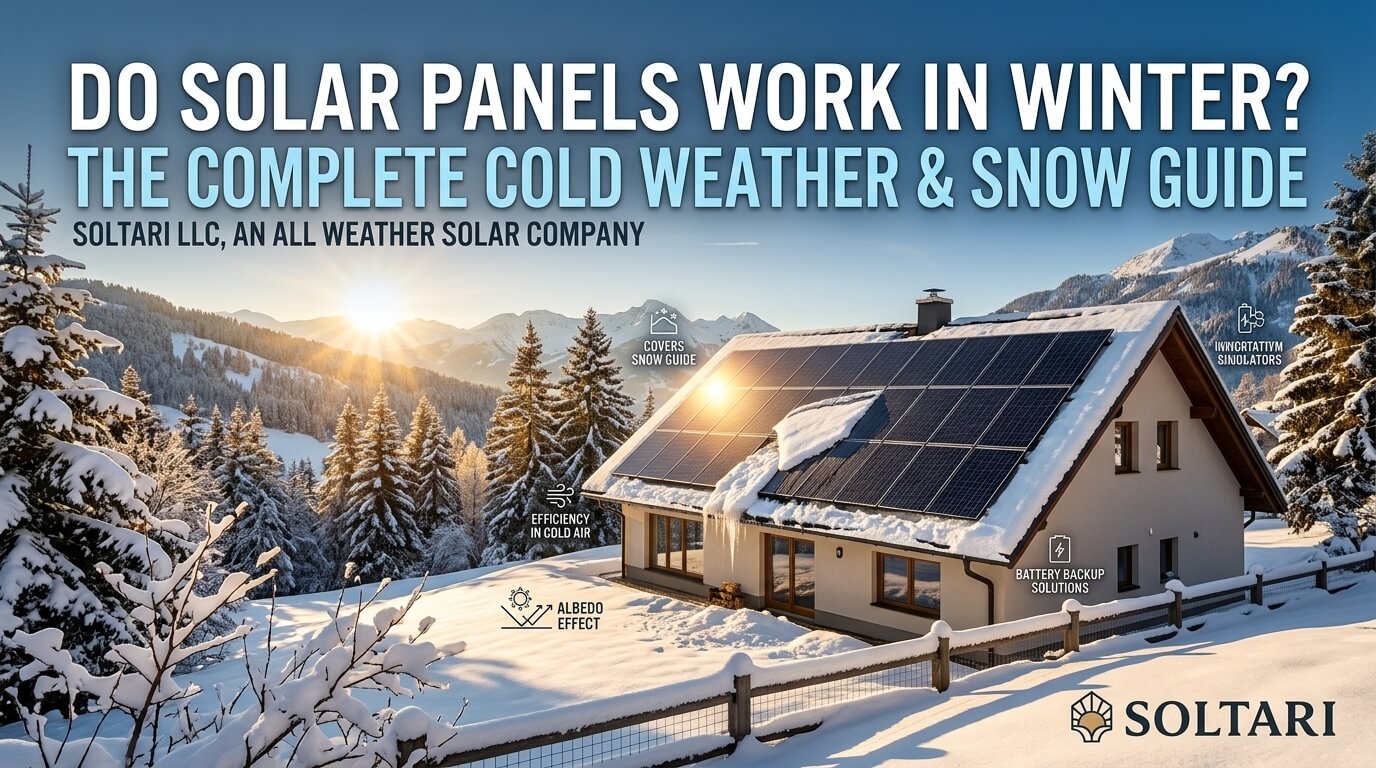
As winter approaches and temperatures drop across California, many homeowners considering clean energy ask one fundamental question: do solar panels work in winter weather? There is a widespread misconception that solar panels require hot summer heat to generate electricity. In reality, solar panels generate power from sunlight, not heat, and cold temperatures actually improve the electrical efficiency of photovoltaic cells. If you want to know do solar panels work in winter, you must understand how photovoltaic technology responds to freezing temperatures, how snow cover impacts energy generation, and how battery backup systems ensure uninterrupted power during winter storm blackouts. This comprehensive guide covers all technical, physical, and environmental aspects of winter solar performance.
The Science of How Solar Panels Operate in Cold Weather
Understanding the physics of semiconductor technology explains why solar panels thrive in cold environments.
Why Solar Panels Produce Electricity from Light Not Heat
Photovoltaic cells convert light energy (photons) directly into electrical current (electrons).
-
Light Dependent: Solar panels do not rely on warmth; they only require daylight. As long as sunlight strikes the silicon cells, the system will generate electricity.
-
The Heat Penalty: Solar panels actually become less efficient as they get hot. Scorching summer heat causes silicon atoms to vibrate excessively, creating internal electrical resistance that drops power output.
-
The Cold Advantage: In crisp, cold winter air, silicon semiconductors experience minimal electrical resistance, allowing electrons to flow more freely. Partnering with established California solar energy providers ensures your system is engineered to capture maximum winter light angles.
Understanding Temperature Coefficients and Cold Weather Efficiency Boosts
Every solar panel has an engineered specification known as the temperature coefficient of power.
-
The Rating: The standard rating measures how much efficiency a panel loses for every degree Celsius the temperature rises above 25°C (77°F), typically around -0.30% to -0.40% per degree.
-
The Winter Boost: Conversely, when temperatures drop below 25°C on a clear winter morning, the solar panel operates at higher voltage and produces more power per hour of direct sunlight than it would on a hot 95°F summer afternoon. This physical principle applies equally to residential arrays and large-scale commercial solar energy installations.
How Diffuse Sunlight Generates Power on Overcast Winter Days
Winter in Northern California often brings overcast skies and coastal fog.
-
Diffuse Light Absorption: Photovoltaic silicon cells absorb both direct sunlight and indirect “diffuse” sunlight that penetrates through cloud layers.
-
Winter Output Levels: On a heavily overcast winter day, modern monocrystalline high performance home solar systems will typically generate between 10% and 25% of their peak rated capacity, ensuring your system continues to produce power even during rainy storm cycles.
Managing Snow Accumulation on Rooftop Solar Arrays
For homeowners in higher-elevation areas (such as the Santa Cruz Mountains or Sierra foothills), understanding do solar panels work in snow is an essential operational question.
Do Solar Panels Work in Snow When Covered
When asking do solar panels work in snow, the thickness of the snow layer dictates production:
-
Light Dusting: A thin dusting of dry snow (under 1 inch) allows a surprising amount of sunlight to pass through the white crystals, enabling the panels to continue producing electricity.
-
Heavy Snow Cover: If a heavy snow blanket (several inches) completely covers the array, sunlight is blocked, and power generation temporarily drops to zero until the snow slides off.
How the Albedo Effect Increases Energy Generation from Ground Snow
Snow can actually boost solar production through an environmental phenomenon called the albedo effect.
-
Light Reflection: Fresh white snow on the ground reflects up to 80% to 90% of incoming sunlight back into the air.
-
Bifacial Generation: Bifacial solar panels (which have glass on both sides) capture this reflected ground sunlight from underneath, generating up to 15% to 30% extra electricity on snowy winter days.
Why Dark Solar Glass Naturally Sheds Snow Faster Than Shingles
Rooftop solar panels are engineered to clear snow naturally without manual intervention:
-
Dark Anti-Reflective Glass: The black silicon cells absorb ambient solar radiation, warming the surface of the panel even in freezing air.
-
Slick Tempered Surface: The smooth glass face offers virtually zero friction compared to rough asphalt shingles.
-
Tilted Slope: Because the panels are mounted at an angle, the bottom layer of snow melts slightly, creating a thin film of water that causes the entire snow sheet to slide off the roof naturally.
Optimizing Winter Solar Energy Production and Battery Storage
Shorter daylight hours in winter require strategic energy management to ensure your household power budget remains balanced.
Adjusting Solar Panel Tilt Angles for Lower Winter Sun Trajectories
In winter, the sun sits lower on the southern horizon.
-
Seasonal Angles: Roof-mounted panels fixed at standard pitches (around 30 degrees) capture excellent year-round light.
-
Ground-Mount Systems: If you have an adjustable ground-mount solar system, tilting your panels to a steeper angle (around 45 to 50 degrees) in late autumn optimizes perpendicular sunlight exposure and allows snow to slide off instantly.
Maintaining Battery Storage Performance in Freezing Temperatures
Energy storage is critical for surviving winter storm outages, but cold weather impacts battery chemistry.
-
Lithium Sensitivity: Standard Lithium Iron Phosphate (LFP) batteries should not be charged at temperatures below freezing (32°F / 0°C) to prevent lithium plating.
-
Internal Heaters: Premium cold weather battery backup systems (such as the Tesla Powerwall 3 or Enphase batteries) feature built-in thermal management systems and internal heating pads that automatically warm the battery cells, ensuring full charging capability even during freezing winter storms.
Managing Energy Consumption and Living Within Winter Power Budgets
Because winter brings fewer total daylight hours (roughly 9-10 hours compared to 14-15 hours in summer), your system’s total daily kilowatt-hour generation will be lower.
-
Conservation Habits: Shift heavy power tasks (like running washing machines or charging electric vehicles) to mid-day hours when the solar array is actively producing power.
-
Grid and Battery Synergy: Under California’s Net Billing Tariff (NEM 3.0), storing daytime winter energy in your battery ensures you avoid purchasing expensive utility grid power during peak evening heating hours (4:00 PM to 9:00 PM).
Summer versus Winter Solar Performance Comparison Table
When evaluating do solar panels work in winter, use this reference table to compare seasonal operational dynamics:
| Environmental Factor | Summer Solar Performance | Winter Solar Performance | Impact on System Output |
| Ambient Temperature | Hot (80°F – 100°F+) | Crisp & Cold (30°F – 55°F) | Cold air increases electrical efficiency |
| Daylight Duration | Long (14 – 15 Hours) | Shorter (9 – 10 Hours) | Fewer total daylight generation hours |
| Sun Trajectory / Angle | High overhead in sky | Low on southern horizon | Requires steep tilt for optimal direct light |
| Cloud & Fog Impact | Minimal (Direct sunlight) | Frequent (Diffuse cloud light) | Diffuse light produces 10% to 25% power |
| Ground Reflection (Albedo) | Low (Dirt / Grass: 10-20%) | High (Snow Cover: 80-90%) | Albedo effect boosts bifacial generation |
| Rooftop Snow Clearance | N/A | Fast natural sliding on glass | Dark tempered glass melts snow quickly |
Preparing Your Solar System for Winter Weather
Ensuring your solar and storage infrastructure is fully prepared for winter storm cycles requires certified engineering.
Why NABCEP Engineering Ensures Structural Snow Load Safety
Heavy snow accumulation adds significant weight (snow load) to a roof structure. At Soltari, LLC, our team of NABCEP-certified designers and C10 licensed electrical contractors designs mounting racking that satisfies strict local snow, wind, and seismic engineering building codes across California. We ensure your racking attachments are anchored directly into heavy roof rafters, preventing structural sagging or leaks during winter storm cycles.
Schedule an All Weather Solar Consultation for Your Home
Don’t let cold weather myths prevent you from gaining energy independence. Get a custom-engineered solar and battery storage proposal designed for all-season California weather. Schedule an all weather solar consultation today to receive an itemized property evaluation, winter generation estimate, and custom energy proposal for your home.
Frequently Asked Questions About Winter Solar Panel Operation
Do solar panels work on cloudy winter days?
Yes. Solar panels generate electricity using diffuse sunlight that penetrates through cloud layers. On a cloudy winter day, high-efficiency monocrystalline solar panels typically produce 10% to 25% of their maximum rated power output.
Should I shovel or scrape snow off my rooftop solar panels?
No, you should never shovel or scrape snow off solar panels. Using metal shovels, rakes, or coarse brushes will scratch the anti-reflective tempered glass coating, voiding your manufacturer warranty. Because the dark glass absorbs heat, snow will naturally melt and slide off on its own as soon as the sun emerges.
Do solar panels generate more electricity in winter or summer?
Solar panels generate more total kilowatt-hours in summer because the days are much longer (14-15 hours of daylight vs. 9-10 hours in winter). However, solar panels operate at higher instantaneous efficiency in cold winter air than on hot summer afternoons due to reduced electrical resistance.
Can freezing temperatures damage solar panels?
No. High-quality solar panels undergo rigorous hail and freeze-thaw testing. They are engineered to withstand extreme temperatures (down to -40°F / -40°C) without cracking or degrading. Cold weather actually helps preserve silicon semiconductor performance.
What happens to my home battery storage system during a winter power outage?
During a winter grid outage, your battery backup system automatically disconnects your home from the utility grid in under 20 milliseconds. It powers your critical household circuits (refrigerator, well pump, heating blowers, lights) using stored energy, and automatically recharges from your solar panels as soon as daytime sunlight returns.
Why do solar panels melt snow faster than the rest of the roof?
Solar panels melt snow faster because the dark silicon cells absorb sunlight and convert a portion of it into heat. Additionally, the smooth, frictionless glass surface allows melted water underneath the snow sheet to act as a lubricant, causing the snow to slide off in large sheets.